

A New Conversation Space on InvariantMath
SHARING AN UPDATE FROM INVARIANTMATH:
Mathematics rarely grows in isolation.
Before a result appears clearly on a page, it often begins as a conversation. A question after a lecture. A message to a colleague. A late-night exchange about whether a proof really works.
Mathematics moves forward through dialogue.
Yet many online mathematical spaces are designed mainly for publishing, not for talking. We have places for papers, lecture notes, problems, and announcements, but the quieter exchanges where ideas begin often happen somewhere else.
That is part of why I decided to build a chat space into InvariantMath.
A place where members of the community can find one another, start private conversations, and talk through ideas in real time.

The experience is intentionally simple. You can search for people, open a thread, reply to earlier messages, and return to recent chats easily.
A conversation can begin just like any ordinary chat between colleagues.
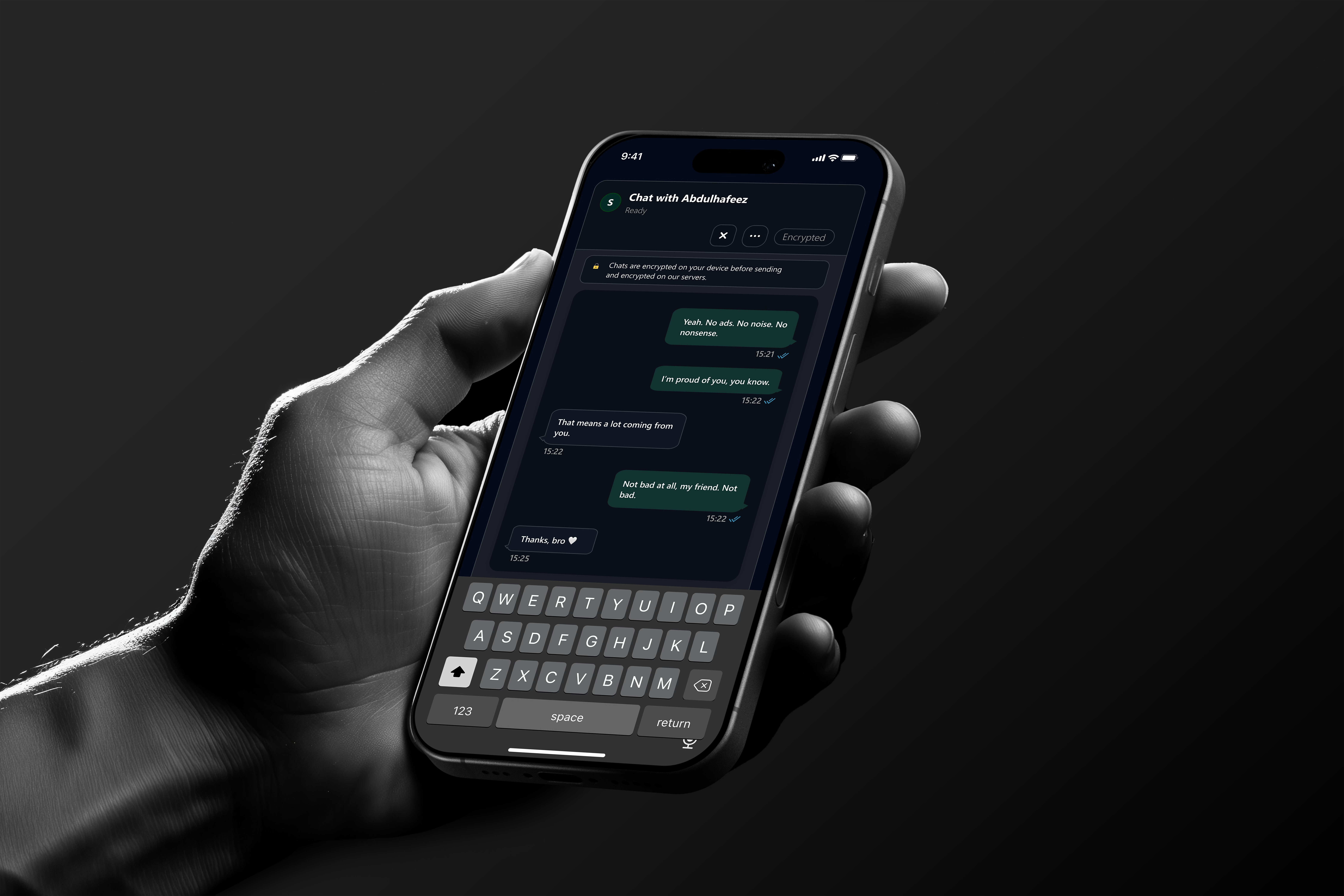
In the conversation below, I am chatting with Daniel, who helps coordinate visual materials for the platform. Much of the design work for InvariantMath involves small exchanges like this while we prepare releases and announcements.
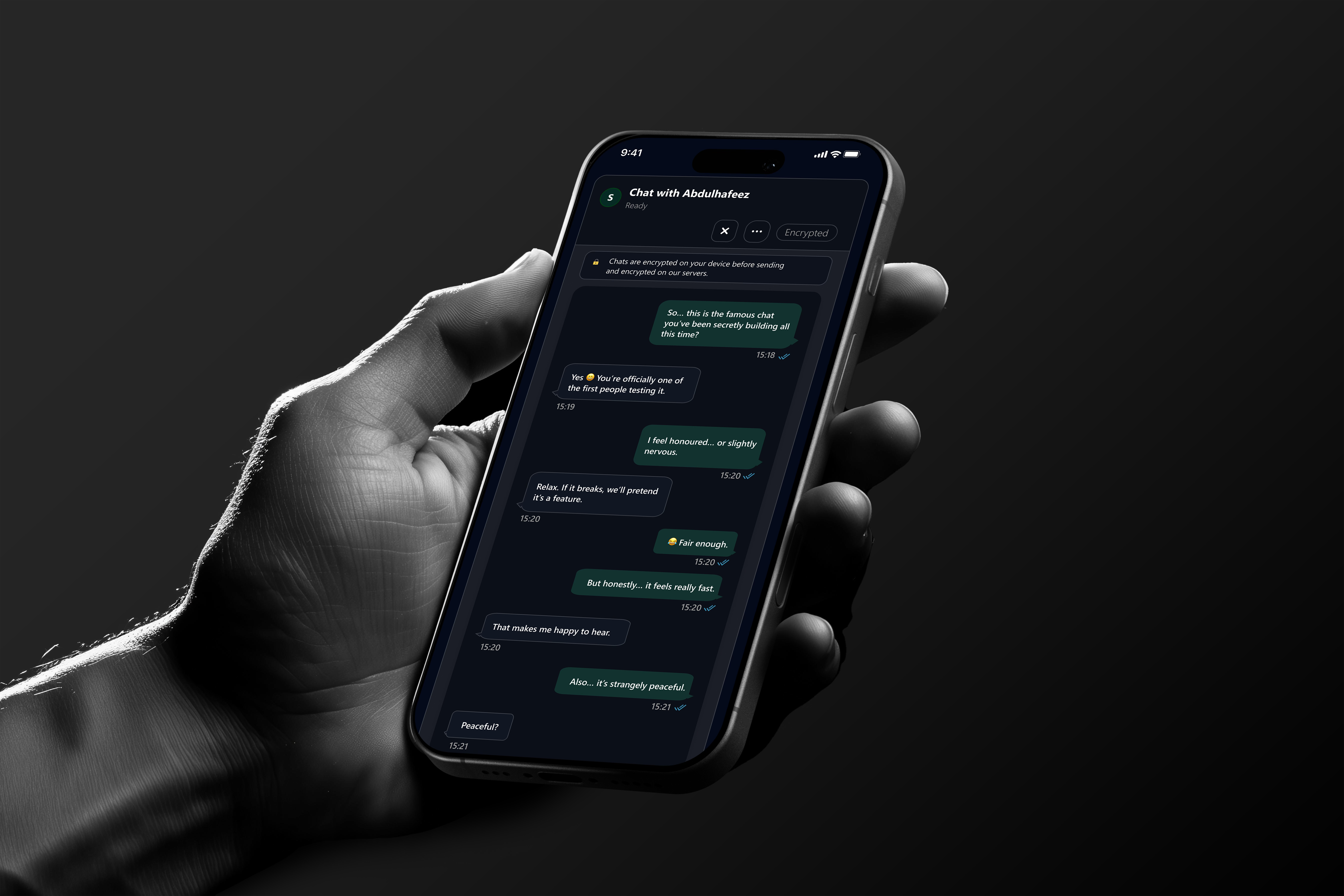
The conversation continues naturally as we refine ideas and respond to one another in real time. These kinds of exchanges are often how small decisions behind the platform are made.
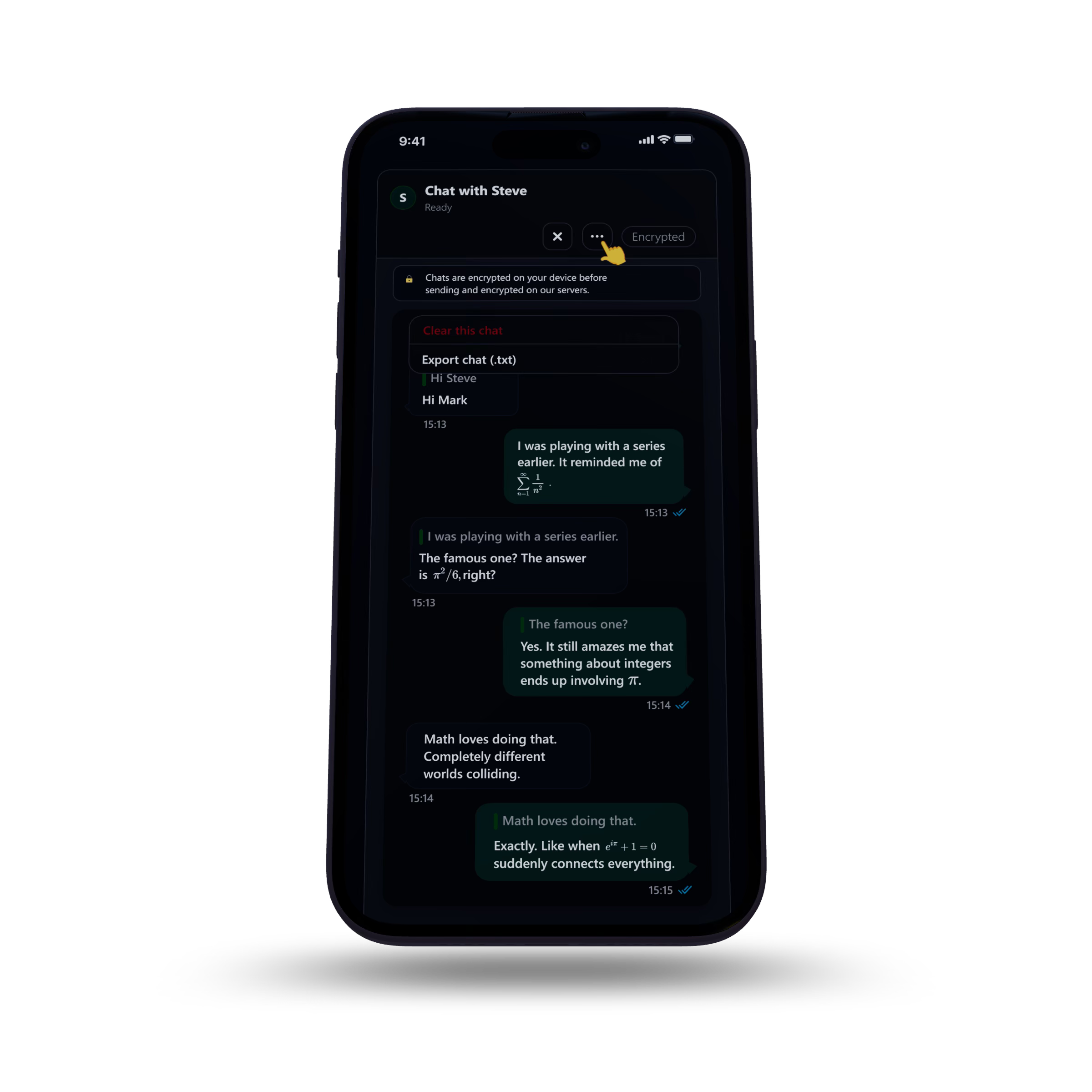
In the next conversation, Mark and Steve are discussing a mathematical idea. The conversation begins informally, just as many mathematical discussions do.

What begins as an ordinary conversation can slowly evolve into a mathematical discussion.
That transition, from casual exchange to structured reasoning, is a natural part of how mathematics grows. The chat space is designed to support exactly that process.
As the chat system took shape, another question naturally followed.
How should privacy work?
Trust comes from the system itself
It is easy to make a chat product look secure. A polished interface, a lock symbol, and a reassuring sentence.
But trust does not come from the icon.
It comes from the system itself.
From the beginning, the goal was not to rely on visual signals of security, but to build a system that protects stored messages properly while remaining practical for a web-based community.
That means designing privacy with care while also ensuring that conversations remain stable and recoverable when people return later.

A small lesson while building the system
During early development, I briefly experimented with a stricter model where message access depended entirely on a locally stored chat key.
This approach worked in principle, but it revealed an important limitation. If the local key was lost or the session state changed, messages could no longer be decrypted.
While testing the system, this happened to me in a conversation with my colleague Olofin, where a few messages appeared with the line:
“Unable to decrypt this message.”
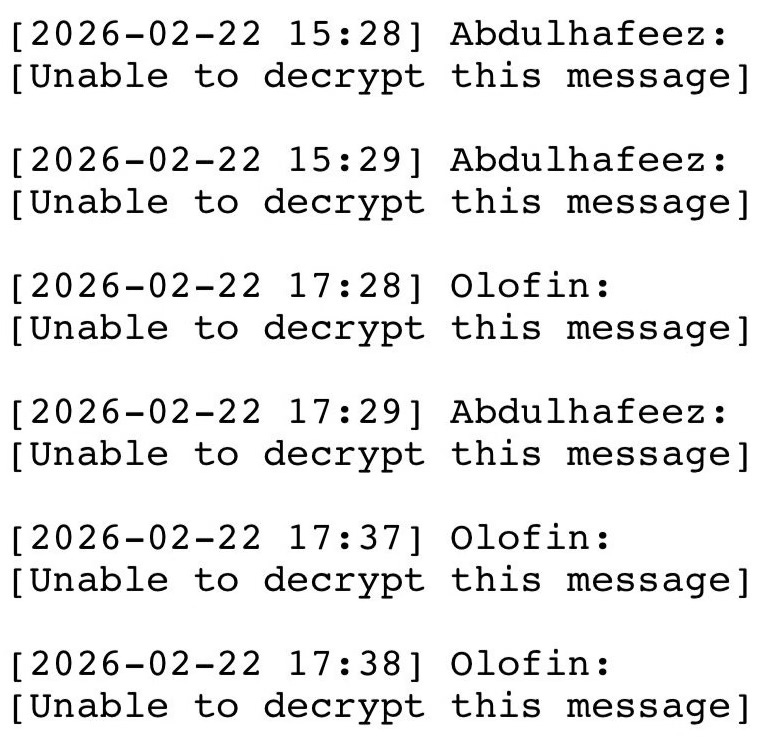
That experience helped shape one of the practical features of the chat system. At that stage, I added a Chat Export option so users could export their conversations and keep a personal copy of discussions whenever they wished.
The system later evolved into the current architecture, where messages are encrypted before storage on the server and conversations remain accessible when users return to their accounts.
The export feature remained, since it still provides a convenient way for users to keep their own copy of conversations whenever they want.
Why this model was chosen
One of the main challenges in web chat is balancing privacy with reliability.
In some messaging systems, encryption keys exist only on a single device or browser session. This can create a very strong privacy model, but it can also make conversations fragile. If the device state disappears, access to the messages can be lost as well.
A familiar example is WhatsApp without a backup. If someone loses their device or clears local storage without a backup, the message history can vanish along with the keys that protected it.
For a web-based mathematical community, that kind of fragility did not feel right. Conversations about ideas, questions, and proofs should remain accessible when someone signs back in.
So the chat system was designed with a different priority. Protect stored messages properly while keeping conversations recoverable and stable for users.
Messages are encrypted before they are stored, and the system uses a structured key model that allows people to return to their conversations safely after signing back in. Normal actions such as logging out, switching devices, or returning later do not interrupt the continuity of a discussion.
The goal is simple. Protect message data while making the experience dependable for the people using it.
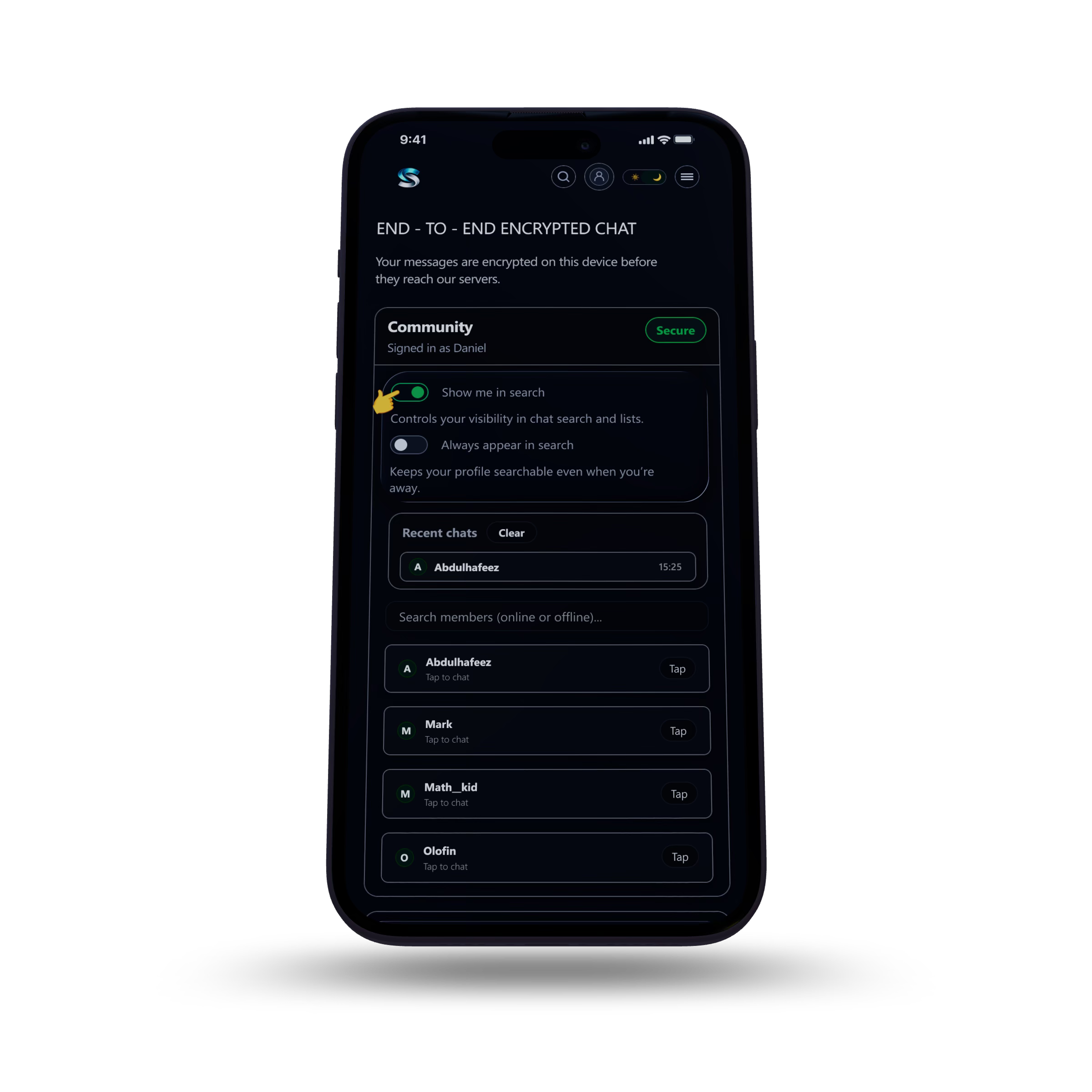
How messages are protected
When a message is sent, it travels through the authenticated application connection to the backend.
Before it is stored in the database, the backend encrypts the message using a modern authenticated encryption scheme called AES-256-GCM (Advanced Encryption Standard with 256-bit keys in Galois/Counter Mode). This means the stored records are not sitting in the database as readable text.
Anyone looking directly at the storage layer would see encrypted data rather than ordinary sentences.
At the same time, the server remains part of the trust boundary because the backend performs the encryption before storage and the decryption when authorized participants load messages.
So the most accurate description is not strict end to end encryption.
It is encrypted server side message storage designed for secure and recoverable web use.
The real goal
InvariantMath began as a place for problems, lectures, and mathematical resources.
But a mathematical community should be more than this.
It is also a network of conversations.
Adding chat is one step toward giving those conversations a home. A place where students, researchers, and curious minds can reach out, ask questions, test ideas, and begin the discussions that eventually become the mathematics we share more publicly.
The system will continue to improve. The security model can grow stronger. The architecture can become more ambitious over time.
But the purpose is already clear.
To give mathematical conversation a place to live.

Abdulhafeez Abdulsalam