
The Problem I Couldn’t Let Go Of: My ICTP diploma thesis with Emanuel Carneiro
SHARING A STORY FROM INVARIANTMATH
By Abdulhafeez Abdulsalam
After my final diploma exam at ICTP, I had to choose a project. I decided to work with Emanuel Carneiro. He taught us functional analysis, a subject many people in my home institution find intimidating, but in his class it felt almost… approachable. He had a way of breaking things down through examples, asking the right questions, and giving exercises that didn’t just test understanding but pushed you to think a bit deeper. He was also very open with students. You could struggle with a problem, walk up to him, and actually talk it through. That kind of environment changes how you see mathematics.
When I asked for a project, I told him I wanted something in his area where I could compute things and build on what I already knew (while still being pushed into something new). He gave me a 2012 paper by him and his collaborators. At first, I could not understand it. Even during a summer school in Slovenia (which he helped me get into), I kept returning to it, trying to make sense of it. With his help and guidance from Julian Weigt (a senior postdoc at ICTP whom he introduced me to), things slowly began to click. What started as confusion turned into curiosity, and then into something I could not stop thinking about.
What the Problem Is Really About
The problem is about proving a simple statement. Let f : ℤ → ℝ be a function of bounded variation.
Is it true that

In other words, if a function has finite total variation, can the centered maximal operator ever increase that variation?
To understand why this is not as simple as it sounds, it helps to think about what averaging does.
If you average a function over a small interval around a point, you expect it to recover the value at that point:

Now fix a small interval around a point. Instead of looking only at the value F(x), you replace it by an average of nearby values. If there is a sharp spike at x, the surrounding values pull the average down. If there is a sudden jump, the average smooths it out.
So averaging tends to flatten peaks and reduce sharp changes.
Now change one thing. Instead of fixing a scale, take all possible averages around a point and keep the largest one:
That small change is where the story begins.
For functions on the integers, the idea is the same: stand at a point, look equally far left and right, average what you see, and keep the largest value:

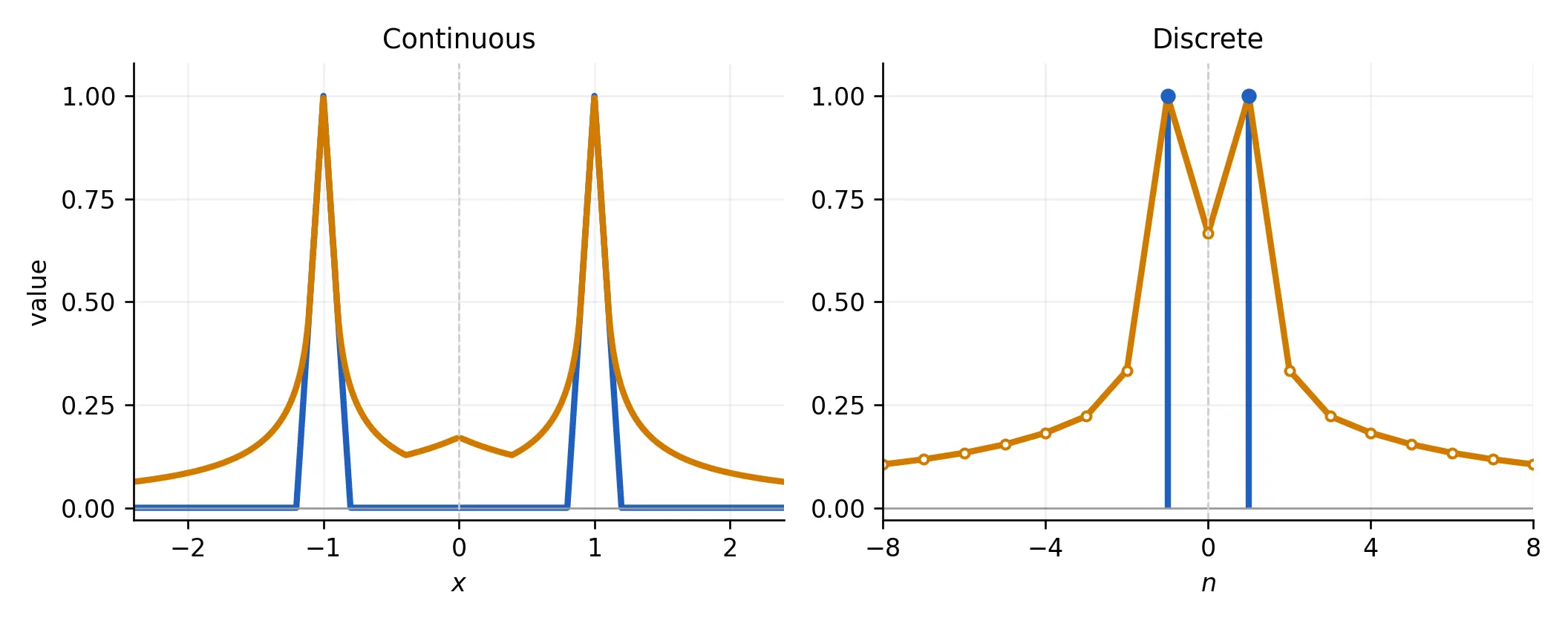
Here is the surprising part. Even if a function is zero at a point, its maximal function may not be. A larger interval can capture nearby peaks and create a new one. This is the heart of the problem.
Here “variation” means total up-and-down movement:
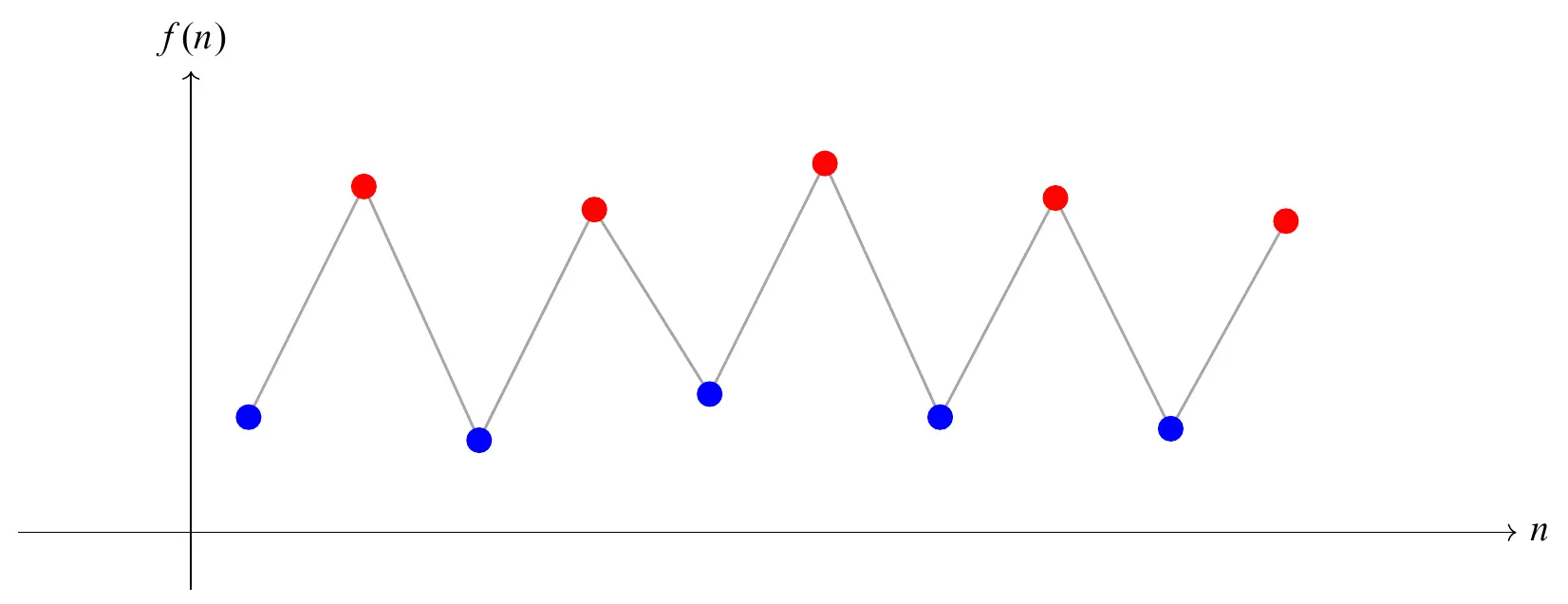
You can think of it as adding up all the rises and drops as you move along the graph. In symbols,

The conjecture is that
always holds. This is the centered discrete variation conjecture. It remains open.
The Two-Spike Obstruction
Here is the picture that made the problem feel alive to me.
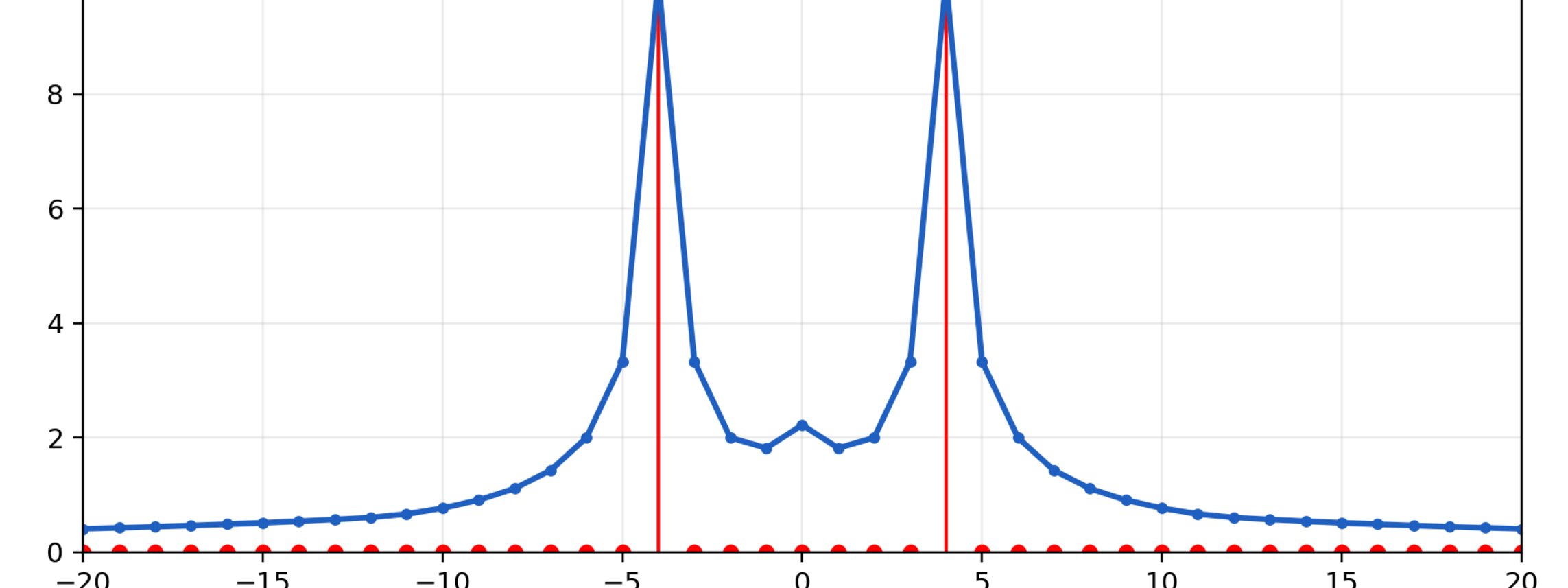
Put two equal spikes on the integer line, one at -4 and one at 4:
 The original function is zero at the origin. But the centered maximal function is not. At n=0, the interval from -4 to 4 catches both spikes, so

In fact, Mf(0) is a local maximum even though f(0)=0.
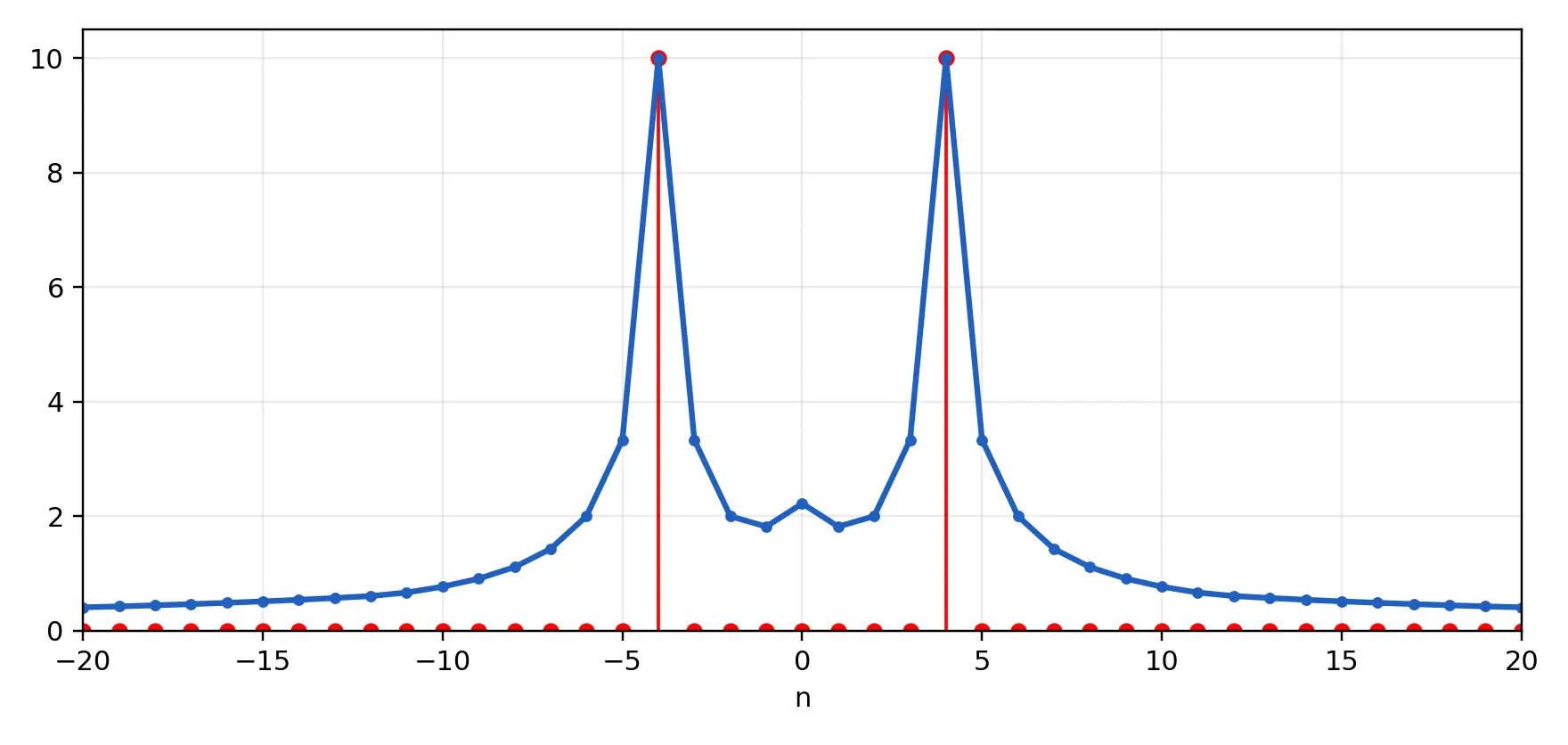
This is where the difficulty appears.
In the non-centered problem, the windows are allowed to slide. We no longer insist on symmetry. Instead of averaging over n-r, ..., n+r, we take all intervals that contain n, even if they lean more to one side:

With this extra flexibility, Bober, Carneiro, Hughes, and Pierce prove a striking touching property: if n is a local maximum of M̃f, then
So the peaks of the non-centered maximal function are not floating in the air. They occur at points where the maximal function touches the original data.
This touching property is central to their proof of the sharp variation inequality

The centered operator breaks this mechanism.
For the two-spike example,
and 0 is a local maximum of Mf. So in the centered case, a local maximum of the maximal function can occur at a point where the original function is zero.
This is why the example matters. The touching property M̃f(n)=f(n) at local maxima is no longer available for the centered maximal operator. As a result, the proof strategy that works in the non-centered case cannot simply be copied.
The centered problem needs a different idea.
Even in this example, the conjecture still holds. The total variation of the original function is Var(f)=40.
In my thesis, I computed the centered maximal function explicitly and found that its variation is smaller:

A small aside: 3680/99 is a repeating decimal,
So in this case one has

So the inequality still holds, but for reasons that are no longer visible on the surface.
What I Actually Did
My thesis sits at the point where exact computation meets structure.
First, I worked out the two-spike obstruction in detail. This explicit computation confirms the conjectured inequality in a test case and shows that Mf can have a local maximum where f=0.
Second, I evaluated sharp higher-dimensional constants in Madrid's discrete ℓ¹-variation theory. The message is simple: the constants come from exact lattice counting.
To make this precise, consider ℓ¹-balls in ℤᵈ, which are discrete diamonds.
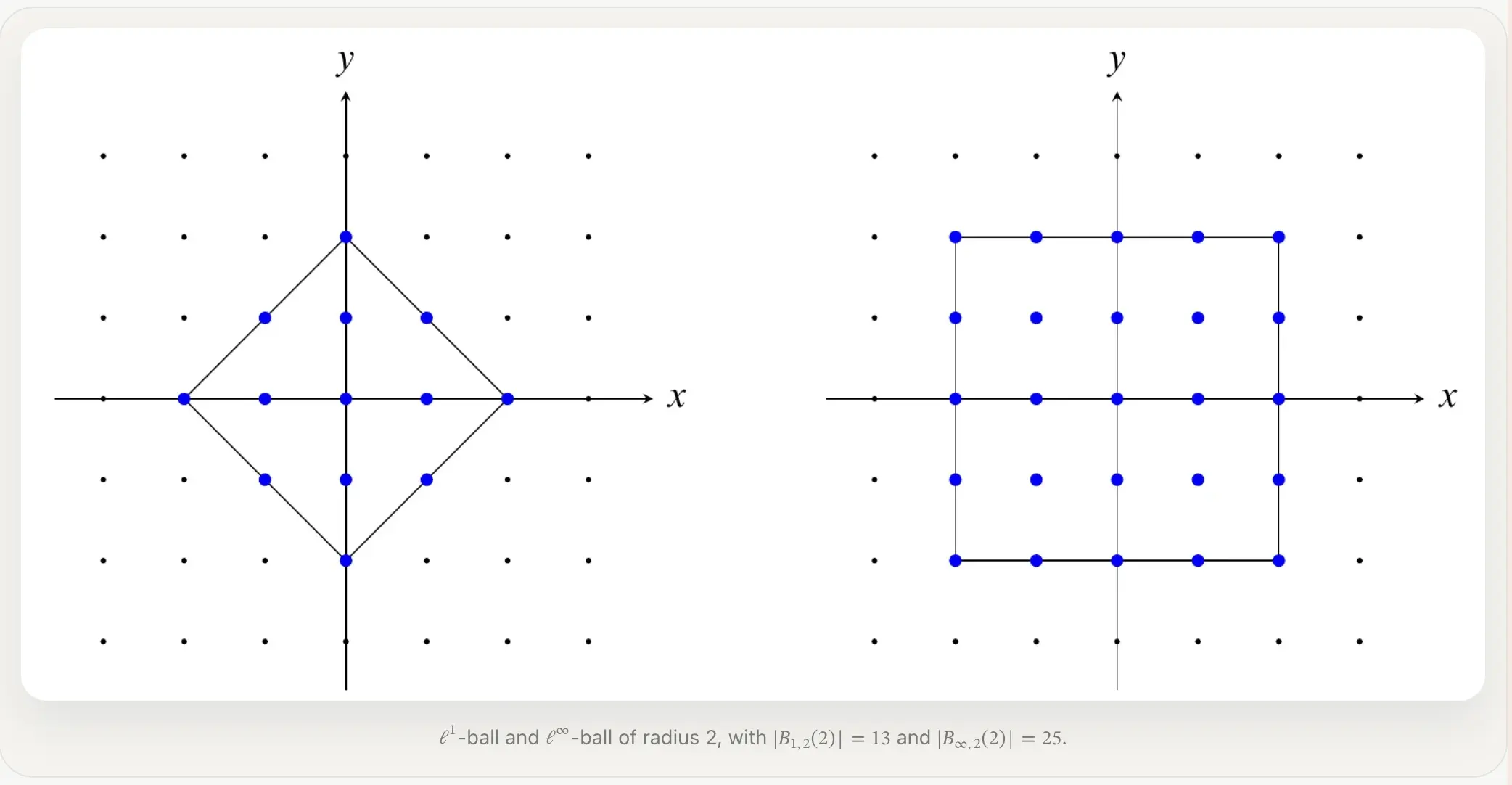
Define

The centered ℓ¹-maximal operator on ℤᵈ is

When d=1, this is just the one-dimensional centered operator M.
Madrid proved the sharp inequality

where

In my thesis, these constants were made explicit. In low dimensions, we have
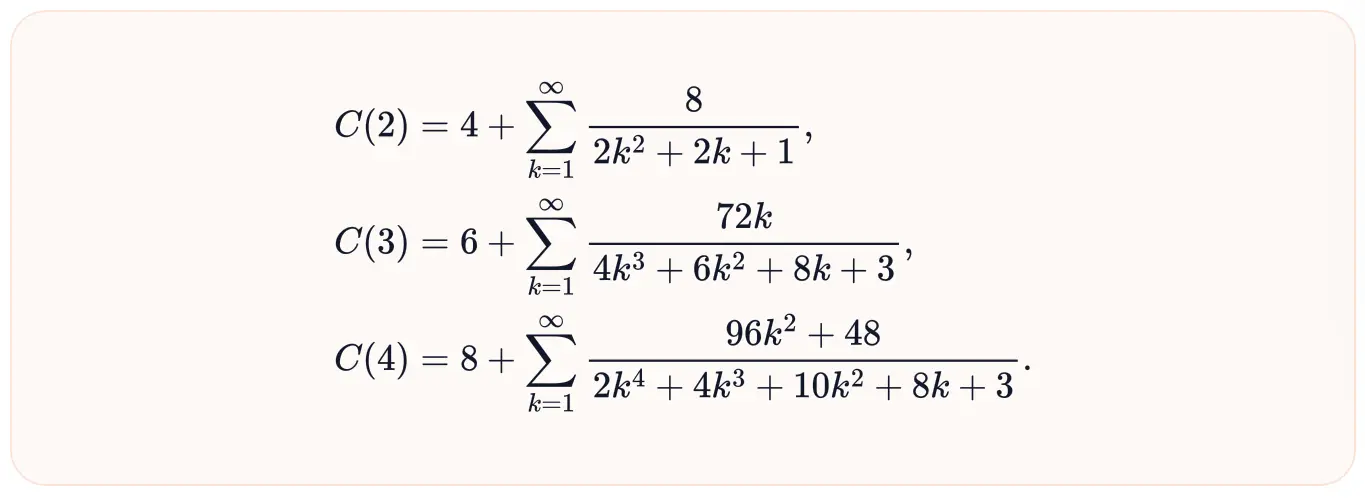
These expressions can also be rewritten using classical special functions. If ψ denotes the digamma function, then

with similar (but more involved) formulas in higher dimensions.
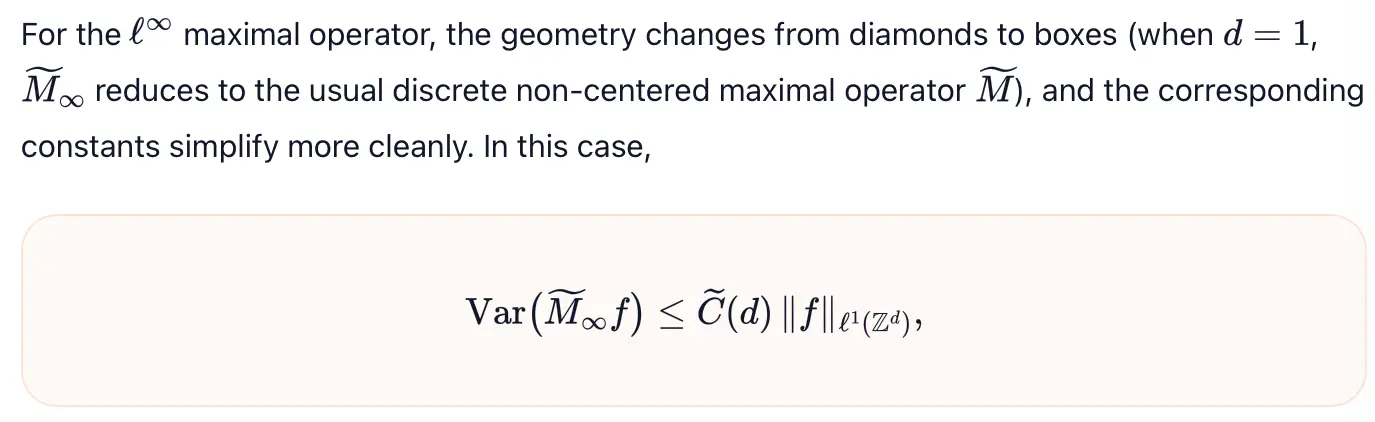
where

and

For example,


Here the coefficients cₖ can be computed explicitly by the formula in the thesis, and ζ(k) denotes the Riemann zeta function.
This contrast between centered and uncentered constants mirrors the main theme of the problem: centered operators retain a rigid structure, while uncentered ones behave more flexibly.
These computations and results are developed in full detail in my ICTP diploma thesis, available on my portfolio.
What Is Known and What Is Changing
The uncentered one-dimensional problem is complete. This is the closest solved cousin, and it shows that centeredness is the real difficulty.
For the uncentered maximal operator, intervals are allowed to slide and need not be symmetric. In this setting, the sharp inequality

is known both in the continuous case (Tanaka; Aldaz and Pérez Lázaro) and in the discrete case (Bober, Carneiro, Hughes, and Pierce).
So the obstruction is not discreteness. It is centeredness.
For the centered problem, strong results are known, but the sharp inequality remains open in full generality. Here BV means bounded variation. Kurka proved a non-sharp continuous BV estimate; his argument gives

Temur proved a direct non-sharp discrete BV estimate, with

These constants are huge compared with the conjectured constant 1, but they were important because they showed that the centered maximal operator does preserve bounded variation. In fact, Kurka's constant 240004 is still the best known BV constant here. Although Kurka's theorem is continuous, it also gives the corresponding discrete estimate by a standard continuous-implies-discrete transfer argument. So one gets, in particular,

Temur's later proof is direct in the discrete setting, but its explicit constant is much larger.
Bober, Carneiro, Hughes, and Pierce also proved the first quantitative centered ℓ¹ estimate:

This was an important starting point because it showed that even in the centered case, the variation of Mf can be controlled by the mass of f.
Madrid, after completing his PhD with Emanuel Carneiro at IMPA (the Institute for Pure and Applied Mathematics in Brazil), sharpened this to the sharp bound
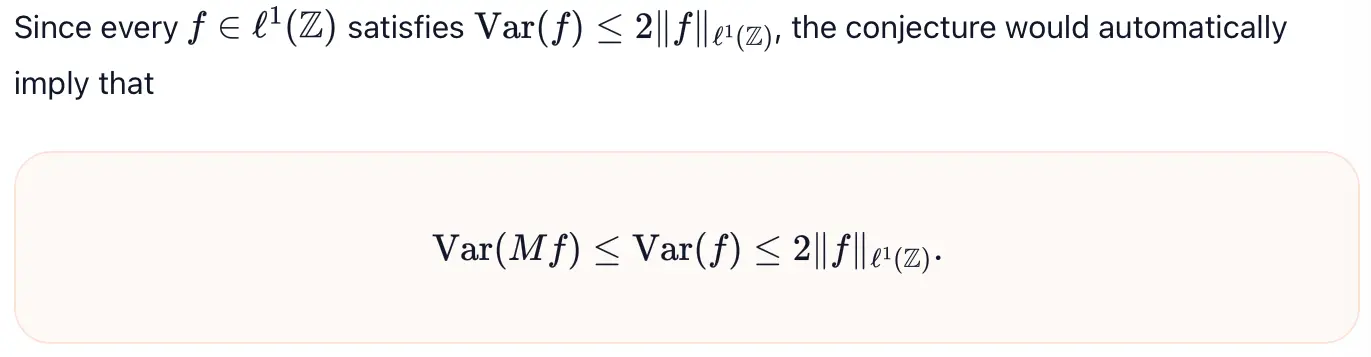
In this sense, Madrid's theorem already captures the strongest ℓ¹-shadow of the conjectured sharp BV estimate.
In the last few years, the problem has become increasingly active. Bilz and Weigt proved the sharp centered inequality for indicator functions, and more generally for a class of functions where the maximal function touches the original data.
A particularly striking development comes from a graph-theoretic viewpoint introduced by González-Riquelme, Kovač, and Madrid. The maximal operator can be defined on finite graphs by averaging over graph balls, and variation can be measured along edges. In this setting, sharp inequalities on finite path graphs Pₙ are closely tied to the original problem on ℤ.
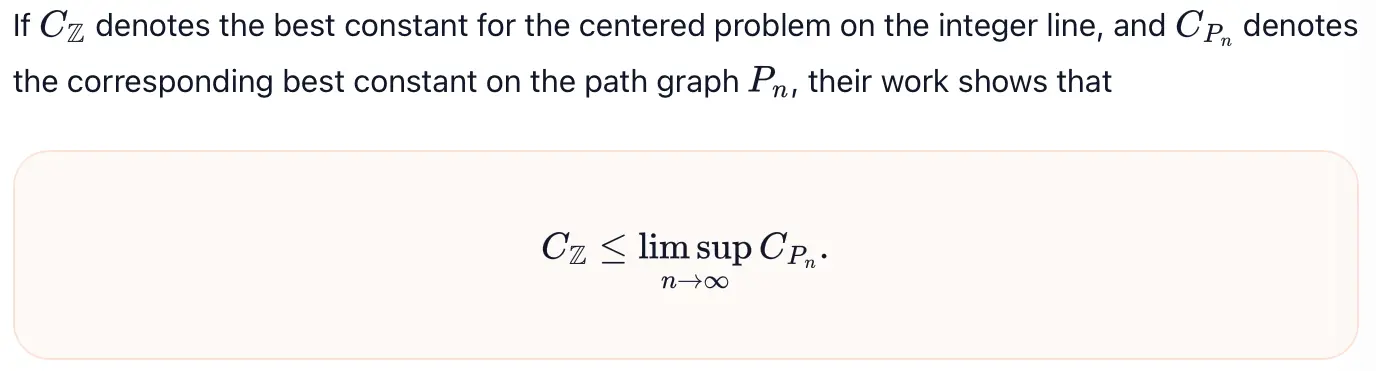
The path graph conjecture says that, for n>3,

This number is strictly less than 1. So the conjecture predicts that finite paths do not merely preserve variation; they actually lose a small amount.
More importantly, the bridge above means that proving

for all path graphs would already imply

That is exactly the centered discrete conjecture. As of now, the central statement remains open:

But the landscape has changed. The conjecture is no longer isolated. It connects to sharp ℓ¹ bounds, indicator functions, refined inequalities, and graph-theoretic models.
Sometimes a problem is solved in one step. Sometimes it is surrounded from many directions until the remaining gap becomes visible. This problem feels like the second kind.
What began as something I could not understand has become a problem I keep returning to.
The statement is simple, the evidence is strong, and yet the mechanism is still hidden.
Somewhere between symmetry, arithmetic, and averaging, there is a missing idea.
Read this story on Invariant Letters.